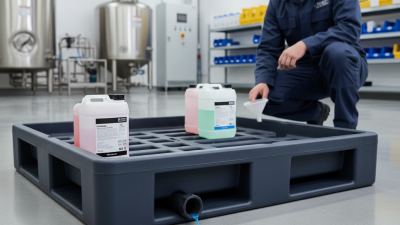
China Top Spill Tray Manufacturers and Suppliers for Global Buyers

Choosing reliable spill tray manufacturers in China requires more than comparing prices and product photographs. Global buyers need evidence of material quality, load performance, chemical resistance, and production consistency. A tray placed beneath a leaking drum must remain stable, even when its surface becomes oily or wet. Small details matter, including raised edges, smooth corners, drainage fittings, and forklift access.

Trevor Kletz, a respected process-safety expert, said, “If you think safety is expensive, try ignorance.” His warning remains relevant when selecting a spill tray for warehouses, workshops, laboratories, and transport areas. A low-cost tray may appear practical, yet poor polyethylene, weak reinforcement, or inaccurate dimensions can create expensive operational problems. Buyers should request material specifications, test records, factory photographs, and sample inspections before placing large orders.

China’s leading manufacturers often provide rotational molding, injection molding, custom colors, and private-label services. Some suppliers also support pallet-sized designs, removable grates, and integrated spill control systems. However, supplier claims still require careful checking. Not every catalogue explains chemical compatibility clearly. Not every “heavy-duty” description proves real load capacity.

This guide examines China’s top spill tray manufacturers and suppliers for global buyers. It considers manufacturing experience, product range, quality controls, customization, communication, and export support. The goal is practical comparison, not exaggerated praise. Buyers can then match tray design with drum size, workplace conditions, and maintenance routines. Sometimes, the simplest tray is the safest choice.
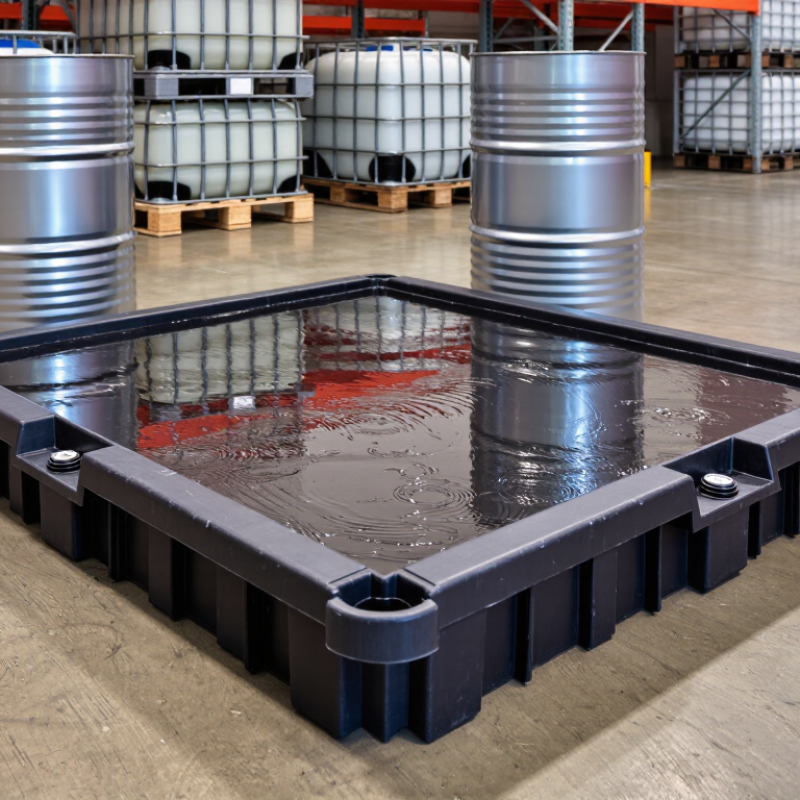
China Top Spill Tray Manufacturers and Suppliers for Global Buyers

Spill Trays Explained: 110% Secondary-Containment Capacity Benchmark

A spill tray is the last barrier beneath drums, IBCs, or transfer points.

The 110% benchmark means its usable capacity should hold 1.1 times the volume of the largest container stored on it. For a 200-litre drum, that is 220 litres.

The UK Environment Agency’s oil-storage guidance uses this benchmark for single containers; where several containers share a tray, it generally calls for 110% of the largest container or 25% of total stored volume, whichever is greater.

Rules vary by location and material, so treat 110% as a design reference, not a universal guarantee.

Real capacity can shrink. A grate, support legs, or rainwater may reduce the space available to contain a leak. Check the tray’s usable volume, chemical compatibility, load rating, and drainage arrangement before purchase.

In the United States, EPA’s 40 CFR 112.7(c) requires containment sized for the largest single container, with allowance for precipitation where relevant. The details matter. A nominal 220-litre tray may not provide 220 litres of clear containment in service.

Tips:

Measure the largest vessel, then verify usable capacity on the supplier’s specification sheet. Keep the tray level and inspect it for cracks, corrosion, and accumulated liquid.

A practical warning: calculations are easy; maintaining clear capacity is less so. Review local requirements and site conditions with a qualified environmental or safety professional.

Materials and Specifications: HDPE, Steel, Load Ratings, and ISO 9001

China’s spill tray manufacturers commonly offer HDPE and steel models for industrial, warehouse, and maintenance applications. HDPE trays resist many chemicals, moisture, and outdoor corrosion. Their lighter weight also helps workers move empty units safely. However, prolonged heat exposure can reduce rigidity. This detail deserves careful review.

Steel trays provide stronger impact resistance and suit heavier containers or busy work areas. Painted or galvanized surfaces can improve corrosion protection, but coating damage may expose bare metal. Buyers should check sheet thickness, weld quality, drain design, and surface finish. A clean weld matters.

Load ratings must match real operating conditions, not only container weight. Consider forklifts, uneven floors, concentrated loads, and repeated handling. Ask suppliers to state static and dynamic capacities separately. A tray rated for 1,000 kilograms may perform differently on a damaged floor. Dimensions should also allow enough clearance around drums and tanks.

ISO 9001 certification indicates a controlled quality management system, not automatic product perfection. Reliable suppliers should provide inspection records, material details, test methods, and traceable production documents. For global buyers, sample approval and pre-shipment inspection reduce avoidable surprises. Some specifications remain unclear until the first shipment, which is why written confirmation is essential.

China Top Spill Tray Manufacturers and Suppliers for Global Buyers

Materials and Specifications: HDPE, Steel, Load Ratings, and ISO 9001

This chart compares common nominal container volumes with a 110% secondary-containment procurement benchmark. The reference sizes are based on widely used 200-liter drums and 1,000-liter IBCs; the two-drum value is calculated as two 200-liter drums. The 110% benchmark is a common buyer requirement, but applicable regulations and site specifications should always be verified.

HDPE spill trays are lightweight and corrosion-resistant, while steel trays are preferred where higher mechanical strength, heavier loads, or fire-related requirements apply. Load ratings must be confirmed from the supplier’s tested specifications and should not be inferred from containment volume. ISO 9001 indicates a certified quality-management system; it does not define a tray’s load rating or spill capacity.

China Supplier Evaluation: Factory Capacity, MOQ, Testing, and Traceability

When evaluating China spill tray manufacturers, factory capacity should mean verified output, not a polished brochure. Request monthly production records, equipment lists, and recent order schedules. A credible supplier should show molding machines, metal-forming equipment, material storage, assembly stations, and inspection areas. Ask whether capacity changes during peak seasons. It often does.

MOQ deserves careful discussion. A low MOQ may support product trials, but it can also hide higher unit costs or unstable production planning. Confirm whether the quoted MOQ applies to one size, one color, or a mixed shipment. Request samples from regular production, not specially prepared pieces. Check wall thickness, surface finish, drainage design, and dimensional consistency. Spill trays should undergo leak testing, load testing, and material compatibility checks when relevant. Test records should include dates, methods, sample quantities, and responsible inspectors. Do not accept vague claims.

Traceability links each tray to its material batch, production date, operator, and inspection result. Ask for batch codes printed on cartons or attached to production records. A reliable factory can explain its corrective-action process when a defect appears. One audit is not enough. Conditions can change after approval. I would schedule follow-up checks, although smaller buyers may find this difficult. That weakness should be acknowledged and managed through retained samples, video inspections, and clear acceptance criteria. Details matter.

Global Compliance Checks: OSHA, REACH, RoHS, and UN Packaging Requirements

For global buyers sourcing spill trays from China, compliance checks should begin before production. OSHA focuses on safe workplace practices, including chemical handling, storage, and spill response. It does not automatically certify every tray. Buyers should confirm material strength, load capacity, chemical resistance, and safe-use instructions. Factory inspection records can reveal weak seams, sharp edges, or unclear labeling.

REACH checks substances used in plastics, coatings, and additives. Request a current material declaration and test report, especially for trays used near solvents or laboratory chemicals. RoHS may apply when the tray includes electrical parts, sensors, or monitoring devices. A basic plastic tray may fall outside its scope. This point is often misunderstood. Ask the supplier to explain the exact product classification.

UN packaging requirements matter when a tray forms part of packaging for regulated dangerous goods. The complete packaging system may require design testing, drop testing, pressure testing, and approved markings. A tray alone does not prove UN compliance. Review test reports, production-batch traceability, and sample performance under realistic temperatures. In practice, documents can look complete while the physical sample differs. Repeat testing after material changes. Keep photographs, declarations, and inspection results in one controlled file. Small gaps deserve attention.

Purchasing Decisions: Compare Pricing, Lead Times, Customization, and Warranty

When comparing China-based spill tray manufacturers, request an itemized quote, not just a unit price. Check steel or polyethylene grade, wall thickness, load rating, tray dimensions, and whether the stated price includes packaging and freight.

A low quote may exclude tooling, sample costs, or protective packing. Details matter. Ask suppliers to quote the same specifications so you can compare like with like.

For custom trays, confirm drawing approval and sample sign-off before production; a small change in sump depth can affect fit beneath a drum rack.

Lead times deserve equal scrutiny. Ask for separate estimates for sampling, production, inspection, and shipping, and confirm what could delay each stage.

McKinsey Global Institute’s 2020 report, Risk, Resilience, and Rebalancing in Global Value Chains, estimated that companies can expect disruptions lasting a month or longer every 3.7 years.

It is not a tray-specific forecast, but it supports building schedule slack into critical orders. Not always easy.

Before placing an order, get warranty terms in writing: coverage period, excluded damage, remedy, and who pays return freight. A warranty without a clear claims process offers limited reassurance.

Request inspection photos or a test record for key dimensions, too; paperwork can miss a rough weld or a drain opening in the wrong place.

Go to Top